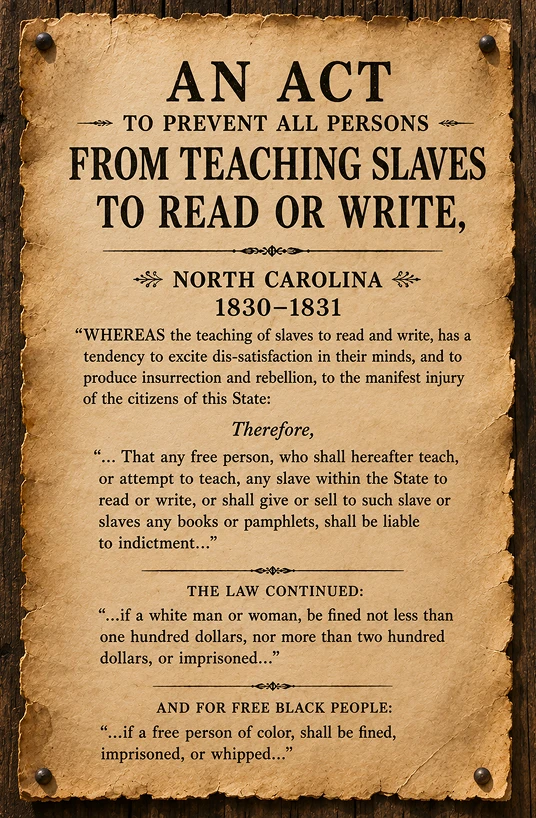
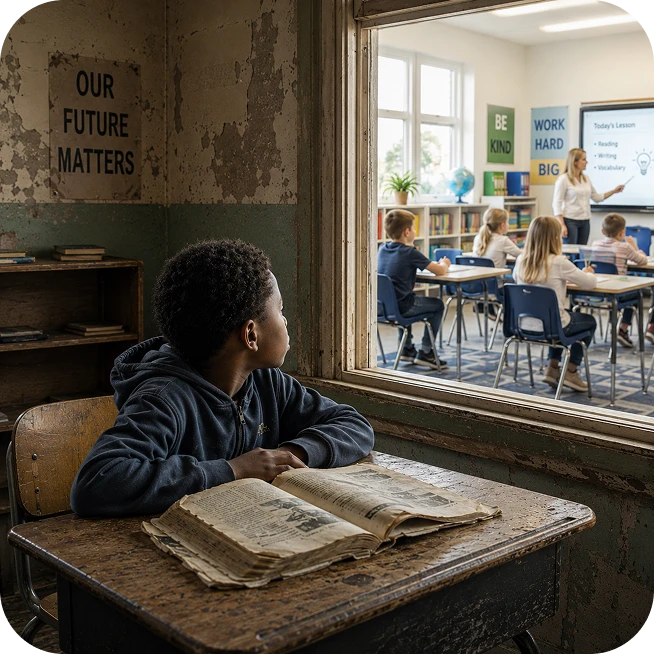
This was America’s vision for enslaved Black America and when we look at today’s reading scores for Black American children, it would appear that vision is alive and well.
That fact alone should force us to understand how powerful literacy truly is. Slaveholders understood that literacy was not merely about reading words on a page. Literacy creates independent thought. It creates awareness. It creates ambition. It creates resistance. A population that can read can organize, question authority, understand the systems around them, and ultimately challenge oppression itself.
That is why throughout slavery, laws were created to keep enslaved Black Americans from learning to read. Teaching an enslaved Black person to read was treated as a crime punishable by fines, imprisonment, violence, and death. America’s anti-literacy laws were not historical accidents. They were strategic tools of oppression.
The fear was never simply that enslaved people would learn words on a page. The fear was that educated Black minds would become impossible to control.
They did not fight to keep us ignorant because they believed we were inferior. They fought to keep us ignorant because they knew we were not.
The laws
changed. The strategydid not.
Slavery ended. The slave codes were abolished. But the project of limiting Black intellectual development did not disappear with emancipation —
it evolved.
It evolved into segregated schools with crumbling textbooks and undertrained teachers while white schools received resources, investment, and opportunity. It evolved into the systematic underfunding of districts where Black children were concentrated. It evolved into reading curricula that ignored decades of scientific research about how children actually learn to read, leaving generation after generation of Black children to struggle while the system called their struggle a personal failure.
And it evolved into what we see today.
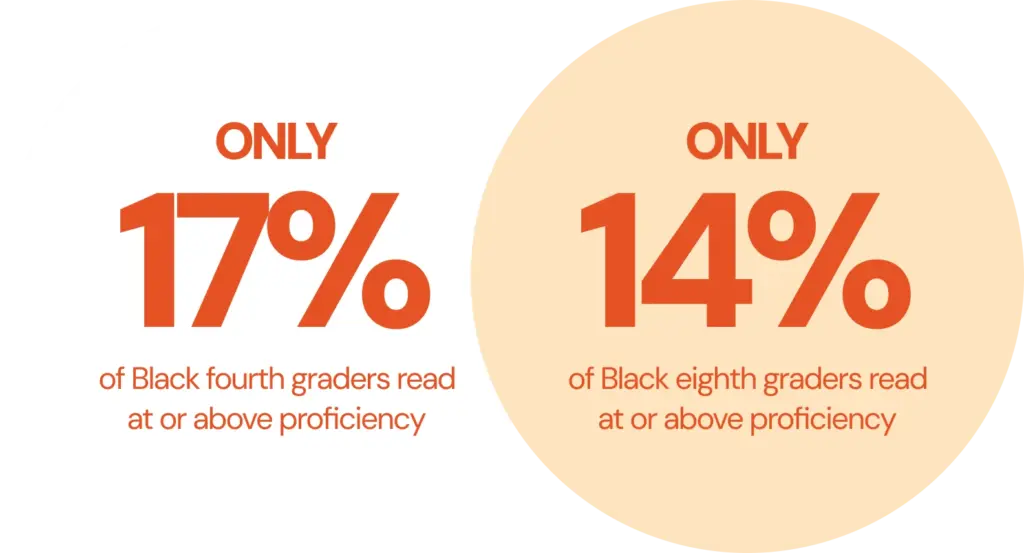
As of 2024, only 17 percent of Black fourth-grade students in the United States read at or above the NAEP Proficient level. By eighth grade, that number falls to 14 percent. In mathematics, it falls to 9 percent. Eighty-three out of one hundred Black children are not reading where they should be.
In 2024.In the richest nationon earth.
To understand the magnitude of this crisis, we must understand what fourth-grade reading proficiency actually means. Fourth grade is the transition point where children stop learning to read and begin reading to learn. History, science, mathematics, writing, civics — all of it depends on a child’s ability to read fluently and comprehend deeply. A child who reaches fourth grade unable to read proficiently does not simply struggle in reading. They begin falling behind in nearly every subject that follows. And the research tells us many never fully recover academically.
Yet still, five out of six Black children are not reading proficiently by the fourth grade.
It is a national crisis.
But here is what makes this even worse.
The system is not only failing to teach our children to read — it is hiding that failure from families.
Children are handed passing grades they did not earn. They are promoted to the next grade without mastering the one before it. Report cards are inflated. Standards are lowered. The appearance of progress is manufactured while our children fall further and further behind in silence, with almost no one sounding the alarm.
So when I say the system is failing our children, I am not speaking emotionally. I am speaking in data. And when I say this failure picks up where the slave codes left off, I am not speaking in hyperbole. I am speaking plainly about the reality in front of us.
AS AN EDUCATED
Black man
Elijah Kajar
Founder
Of The Black Children Reading Academy
I can read the history. I can read the research. I can connect the dots from 1740 to 2024, from South Carolina’s Negro Act to today’s NAEP report card showing that five out of six Black children are not reading where they should be. And what I see is not a disconnected series of events, but a direct-line — a long history of Black intellectual suppression that never fully ended, only adapted.
But I also see something else.
I see our ancestors, who taught each other to read in secret while risking beatings and death. I see Reverend John Berry Meachum, who — when Black education was outlawed in St. Louis — moved his school onto a steamboat in the Mississippi River so he could continue teaching outside the reach of the law. I see Frederick Douglass trading bread for reading lessons because he understood even as a child that literacy was connected to freedom itself.
I see generation after generation of Black Americans who refused to accept the intellectual cage this country attempted to build around them.
That refusal is in our blood. BCRA is its continuation. America’s vision for Black children does not have to remain our reality.
It is time
for a new vision
A vision where Black children are no longer disproportionately struggling readers, but highly educated, highly capable young people equipped to think critically, compete academically, build businesses, lead communities, and shape the future for themselves.
A vision where literacy is treated not as an optional academic benchmark, but as a form of empowerment, protection, and liberation.
A vision where families and communities stop blindly trusting systems that have repeatedly failed our children and instead take direct responsibility for ensuring our children receive the reading education they deserve.
That vision is the Black Children Reading Academy.
BCRA exists because we will no longer gamble with our children’s minds.
We send our children into school systems that produce one proficient Black reader out of every six students and call it education.
We watch children fall behind in the early grades and hope the system will somehow catch them later.
We have normalized literacy failure in our communities even though the consequences are devastating and lifelong.
BCRA exists because we are done accepting that.
We believe teaching literacy is revolutionary.
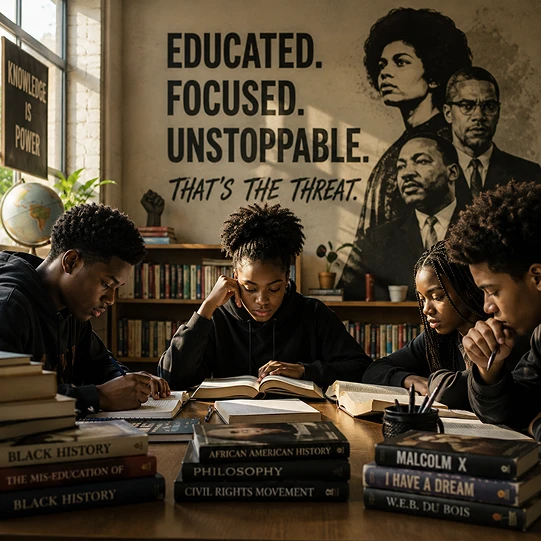
Because every child who learns to read fluently becomes harder to mislead, harder to silence, and harder to control.
Literacy
is not merely
Education
it is liberation
A strong reader becomes a stronger thinker.
An educated child becomes an empowered adult.
And a population of strong thinkers is a threat to oppressive systems.
The mission of the Black Children Reading Academy is to ensure that every student in our program reads at or above grade level by the time they reach fourth grade — or sooner. We accomplish this through systematic, Science of Reading–based instruction, small-group learning, mastery-based progression, and an active family partnership model that extends the classroom into the home.
This is bigger than tutoring. This is bigger than test scores.
This is about breaking cycles that have existed for generations.